Every year, management teams sit down for “strategic planning”. They come out with a long list of projects, a hiring plan and a budget, and they call it a strategy. In most cases it is not. It is a plan. And the difference matters more than most leaders realise.
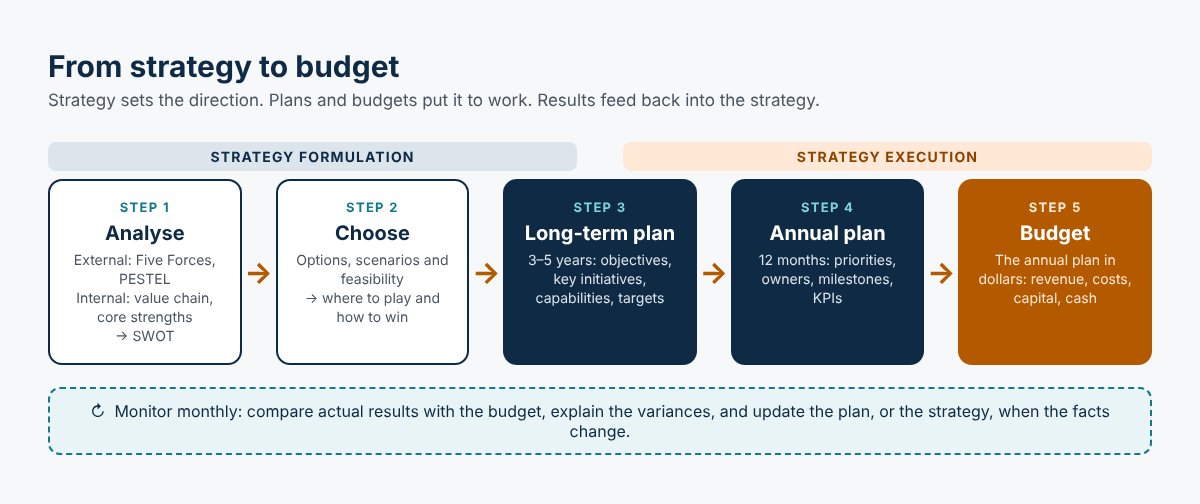
In this article I explain the difference between strategy and planning, show how to build a real strategy, and then walk through how that strategy becomes a long-term plan, an annual plan and, finally, a budget.
Strategy vs. planning
Roger Martin, the former dean of the Rotman School of Management, makes a point I find very useful: most “strategic planning” is really just planning. It is a checklist of things each department will do this year (build a plant, launch a product, hire staff) without one idea that ties them together.
| Planning | Strategy | |
|---|---|---|
| Focus | Resources, activities and costs | Customers, competitors and outcomes |
| What it controls | Things inside the company | Things you cannot fully control: customer choices |
| How it feels | Comfortable and familiar | Uncomfortable: it involves real risk |
| Key question | What will we do and what will it cost? | Where will we play and how will we win? |
Leaders gravitate to planning because it is comfortable. Costs and activities are within your control. Strategy is uncomfortable because it is a bet on how customers and competitors will behave, and you cannot prove in advance that it will work.
A simple definition I use with my students: strategy is an integrated set of choices about where to play and how to win, so that target customers choose you over anyone else.
A classic example: Southwest Airlines
For years, most large U.S. airlines were “playing to participate”. They bought planes, added gates and managed costs, but they did not have a clear way to beat each other. Southwest made a different choice. Instead of competing head-on with the full-service airlines, it set out to be a fast, affordable alternative to driving or taking the bus.
Every operating decision supported that one choice: point-to-point routes instead of hubs, a single aircraft type (the Boeing 737), no in-flight meals and direct booking. Each choice lowered costs and reinforced the others. The result was a low-cost, high-frequency airline that could undercut competitors on price and take market share for decades.
That is what strategy looks like: not a list of projects, but choices that fit together.
How to avoid the planning trap
- Accept the discomfort. Strategy always involves uncertainty. Being willing to make choices you cannot prove in advance is part of leadership, not a sign of poor management.
- Write down what must be true. For your strategy to work, what must be true about your customers, your industry and your own capabilities? This becomes your early-warning system: if one of those conditions changes, you know to revisit the strategy.
- Keep it to one page. A strategy that needs fifty slides is usually a plan in disguise.
The one-page strategy answers five questions:
- What is our winning aspiration?
- Where will we play?
- How will we win there?
- What capabilities must we have?
- What management systems do we need to support those capabilities?
How to formulate a strategy
Strategy is a creative act, but it is not guesswork. This is the step-by-step process I teach.
Step 1: Look outside the company
Start with the environment. Two tools are especially useful:
- Porter’s Five Forces, developed by Michael Porter at Harvard, helps you understand how attractive an industry is and where the pressure on your profits comes from.
- PESTEL looks at the wider environment: political, economic, social, technological, environmental and legal trends.
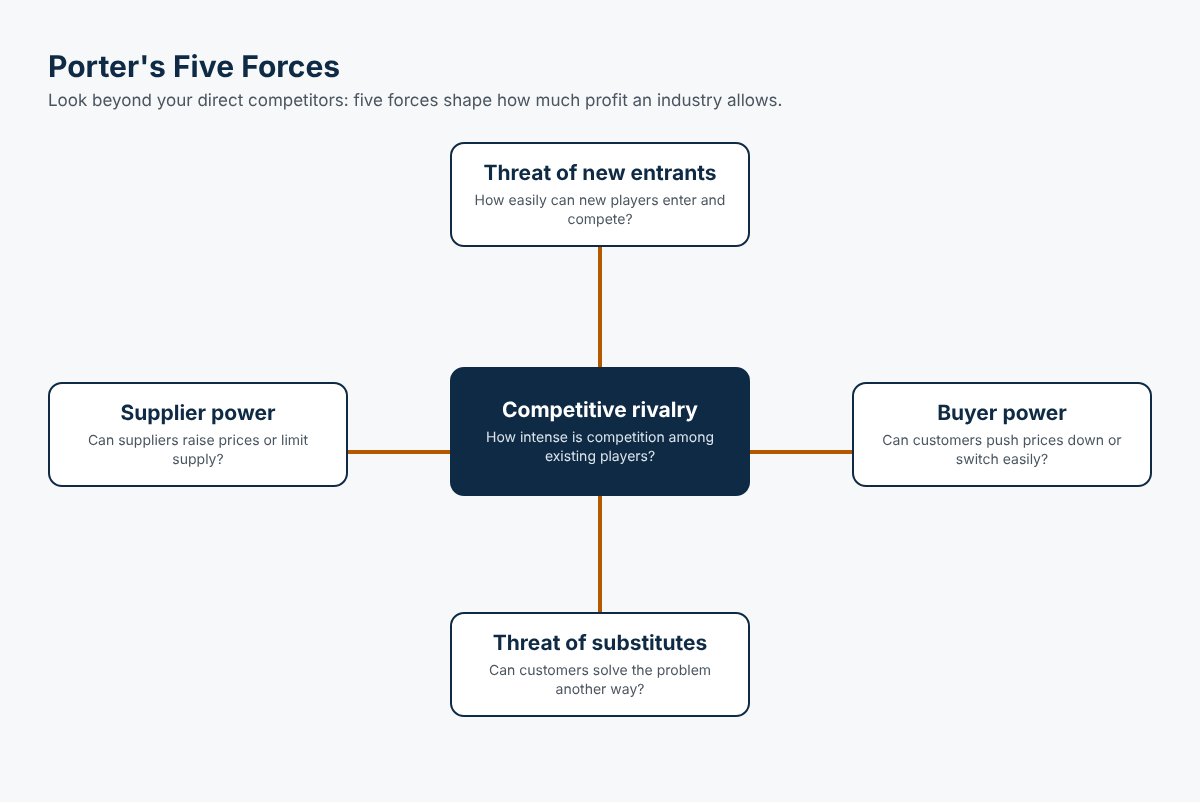
The point of the Five Forces is to look beyond your direct competitors. A business can face little head-to-head rivalry and still struggle if customers can easily switch to a substitute or if one supplier controls a critical input.
Step 2: Look inside the company
Next, be honest about your own position. Map your value chain, the activities through which you create value, and identify your core competencies: what you do better than others and is hard to copy.
Step 3: Bring it together in a SWOT
Combine the two views. Strengths and weaknesses come from the internal analysis; opportunities and threats come from the external one. A good SWOT is short and specific. “Strong team” is not a strength; “the only team in our market with regulatory approval in three provinces” is.
Step 4: Generate strategic options
Use the SWOT to create several genuinely different options. Each option should be a clear answer to “where will we play and how will we win?”
The main types of strategy to choose from
It helps to know the classic strategy types before you build your options. They give you a vocabulary and stop you from mixing choices that pull in opposite directions.
1. Porter’s generic strategies: how you compete
Michael Porter argued that a company earns above-average returns in one of two basic ways, by having the lowest costs or by offering something customers value enough to pay more for, and that it applies that choice either to a broad market or to a narrow segment.
| Strategy | How you win | Example | Watch out for |
|---|---|---|---|
| Cost leadership | Be the lowest-cost producer in the industry, then win on price or earn higher margins at market prices | Walmart, Southwest Airlines | Competitors copying your cost advantages; cutting the quality customers still expect |
| Differentiation | Offer something unique (design, quality, brand, service, technology) that customers will pay a premium for | Apple | Customers deciding the extra value is not worth the higher price |
| Cost focus | Be the low-cost option for one specific segment or region | A discount grocer serving one region | A larger low-cost player entering your niche |
| Differentiation focus | Serve a narrow segment better than anyone else, with a tailored product | Software built only for dental clinics | The niche being too small, or broad players adding the same features |
Porter also warned about being “stuck in the middle”: trying to be cheapest and most premium at the same time, and ending up neither. Some strategy textbooks describe a fifth option, the best-cost provider, which offers good features at a lower price than rivals. IKEA is often given as an example. It can work, but only when the company has a genuine cost advantage that funds the extra value.
2. Value disciplines: what you are famous for
Michael Treacy and Fred Wiersema found that market leaders usually excel at one of three “value disciplines”, while staying good enough at the other two:
- Operational excellence: reliable products at the best price with the least hassle.
- Product leadership: the most innovative, leading-edge products.
- Customer intimacy: deep knowledge of each customer and solutions tailored to them.
This is a useful test for founders: if you cannot say which of the three you lead on, your team will not know either.
3. Ansoff’s growth matrix: where you grow
Igor Ansoff’s matrix looks at growth through two questions: are you selling existing or new products, to existing or new markets?
| Existing products | New products | |
|---|---|---|
| Existing markets | Market penetration: sell more to the customers you already serve (lowest risk) | Product development: new products for your current customers |
| New markets | Market development: take your current product to new regions or segments | Diversification: new products for new markets (highest risk) |
4. Blue ocean strategy: changing the game
W. Chan Kim and Renée Mauborgne of INSEAD describe “red oceans”, crowded markets where companies fight over the same customers, and “blue oceans”, new market space where competition is less relevant. Instead of choosing between low cost and differentiation, a blue ocean strategy removes or reduces features the industry takes for granted and adds new ones customers value. Their best-known example is Cirque du Soleil, which reinvented the circus for an adult, theatre-going audience.
A note on pricing
Pricing tactics such as tiered plans, discounts or premium pricing are not a strategy on their own. They should follow from your strategy. A cost leader prices to win volume; a differentiator prices to capture the value it creates. Your pricing should make it obvious which one you are.
How to use these frameworks
Use them to build two or three distinct options, for example “the low-cost option for small firms in Ontario” versus “the premium, highly tailored option for mid-sized companies”. Then test them in Step 5. The frameworks will not choose for you, but they make sure your choices are clear and consistent.
Step 5: Test the options
Run each option through scenario analysis (what happens if the market grows quickly, slowly or shrinks?) and a feasibility check:
| Feasibility test | Question to ask |
|---|---|
| Economic | Is it cost-effective? Do the expected benefits justify the investment? |
| Operational | Will it actually solve the problem and capture the opportunity? |
| Technical | Do we have, or can we get, the technology and expertise? |
| Schedule | Can it be delivered in the time we have? |
| Legal | Does it fit within our legal and contractual obligations? |
| Organizational | Will people inside the company support it? |
Step 6: Choose and commit
Pick one option, write it on one page using the five questions above, and list what must be true for it to succeed. That page is your strategy. Everything that follows is about executing it.
From strategy to a long-term plan
The long-term plan, usually three to five years, translates the strategy into objectives and major initiatives. It answers: what do we need to achieve, and what big moves will get us there?
- Strategic objectives: the few outcomes that show the strategy is working, such as reaching a target market share or entering two new markets.
- Key initiatives: the major projects needed, for example a new product line, a sales expansion or a new ERP system.
- Capabilities: the people, systems and partnerships to build or buy.
- Financial targets: revenue, margin and cash targets for each year.
- Risks: what could go wrong and how you will reduce it.
A Balanced Scorecard is a practical way to organise these objectives across four views: financial, customer, internal processes, and learning and growth. It keeps the plan from becoming a purely financial exercise.
From the long-term plan to the annual plan
The annual operating plan takes the first year of the long-term plan and makes it concrete:
- The three to five priorities for the year
- An owner for each priority
- Quarterly milestones
- The KPIs that will show progress
If an activity in the annual plan does not connect to the strategy, question whether it belongs there at all.
From the annual plan to the budget
Budgeting translates strategic priorities into a plan of what needs to be done and achieved during the next year. When that plan is expressed in financial terms, it is called a budget. A complete budget is built in a logical order:
- Sales budget: expected volumes and prices. Everything else depends on this, so be realistic.
- Operations budget: what it will take to deliver those sales, including production or service delivery, inventory and direct costs.
- Operating expense budget: salaries and hiring, marketing, technology, rent and administration.
- Capital budget: major investments in equipment, systems and facilities.
- Cash budget: when cash comes in and goes out, month by month. For a startup, this is the most important budget of all.
- Budgeted financial statements: the projected income statement, balance sheet and cash flow that bring it all together.
Budgeting for a major initiative
Large initiatives, such as a new ERP system, deserve their own business case inside the budget. Estimate the benefits in four categories:
- Revenue enhancement: new sales opportunities.
- Revenue protection: keeping the revenue you already have.
- Cost savings: removing manual, low-value work or errors.
- Cost avoidance: preventing costs that would otherwise rise in the future.
Then estimate the full cost, not just the purchase price:
- Acquisition costs: hardware, software, networking, development, project management, consulting and training, plus the indirect cost of disrupting current operations.
- Operating costs: maintenance contracts, upgrades, hardware replacement, help desk support, ongoing training, administration and eventual decommissioning, plus the hidden cost of user downtime and lost productivity.
Keep the loop closed
A budget is not a document you approve once and file away. Compare actual results to the budget every month, understand the variances, and ask whether the assumptions behind the strategy still hold. If they do not, update the plan, and if necessary the strategy itself. Many companies now use rolling forecasts so they always look twelve to eighteen months ahead.
A note for startups
You do not need a forty-page plan. A one-page strategy, a simple 18 to 24-month financial model and a monthly cash budget will take you a long way. What matters is that every dollar in the budget connects back to a clear choice about where you play and how you win.
My take
Plans and budgets are essential, but they are tools for executing a strategy, not a replacement for one. Start with the hard choices, write them on one page, and only then build the plan and the budget. If your budget could belong to any company in your industry, you probably do not have a strategy yet.


Leave a Reply